The National Center of Meteorology (NCM) today issued a statistical report on the lowest recorded temperatures and frost cases over the Kingdom's regions during the winter seasons (December, January, and February), for the period of time from 1985 to 2025, based on the climatic records approved by the center.
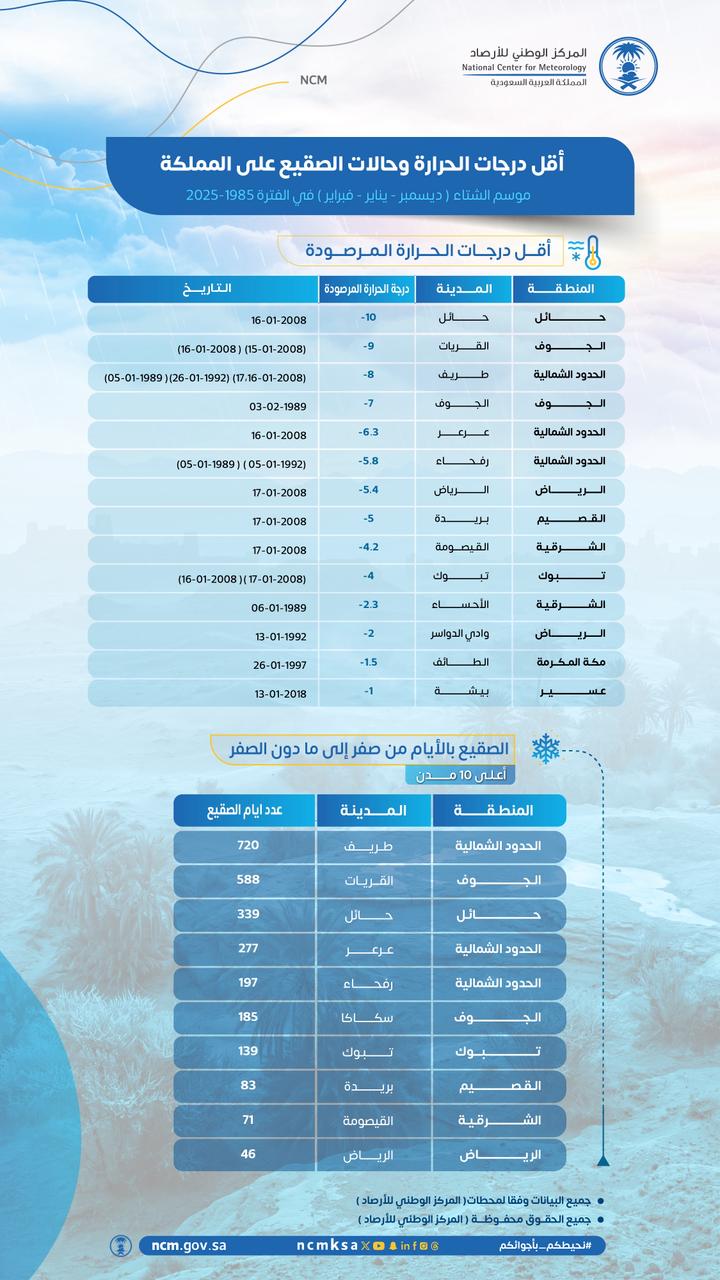
The report revealed that the lowest temperature recorded at the level of the Kingdom during the period reached minus 10 degrees Celsius in the city of Hail on January 16, 2008, followed by the city of Qurayyat in the Al-Jawf region with a temperature of minus 9 degrees Celsius in January 2008, while it recorded a temperature of minus 8 degrees Celsius in the city of Turaif in the northern border region during different years, and the city of Al-Jawf recorded a temperature of minus 7 degrees Celsius in February 1989.
The report showed that low temperatures were recorded in a number of other cities, including Arar (-6.3°C), Rafha (-5.8°C), Riyadh (-5.4°C), Buraydah (-5°C), Qassim (-4.2°C), Tabuk (-4°C), Al-Ahsa (-2.3°C), Wadi Al-Dawasir (-2°C), Taif (-1.5°C), and Bisha (-1°C), during different time periods within the scope of the study.
The center pointed out that the year 2008 is one of the most recorded years for the lowest scores in a number of cities, including Hail, Riyadh, Buraidah, Qassim, and Tabuk, in addition to other cities.
The report monitored the top 10 cities in the number of frost days during the period from 1985 to 2025, at the forefront of which were the northern, eastern and central regions, where the city of Turaif in the northern border region topped the list with 720 days, followed by the city of Qurayyat in the Al-Jawf region with 588 days, then the city of Hail with 339 days, followed by the city of Arar with 277 days, then Rafha with 197 days, then Sakaka with 185 days, while the city of Tabuk recorded 139 days, the city of Buraydah with 83 days, the city of Qaisumah with 71 days, and the city of Tabuk recorded 139 days, the city of Buraydah with 83 days, the city of Qaisumah with 71 days, and the city of Tabuk recorded 139 days, the city of Buraydah with 83 days, Al-Qaisumah with 71 days, and the city of Al-Qaisumah Riyadh 46 days of frost.
The issuance of this report comes as part of the National Center of Meteorology's efforts to analyze and document long-term climate records, support studies, and raise awareness of the climatic characteristics of the Kingdom's regions, thus contributing to enhancing readiness and planning based on reliable data.

 العربية










.png)