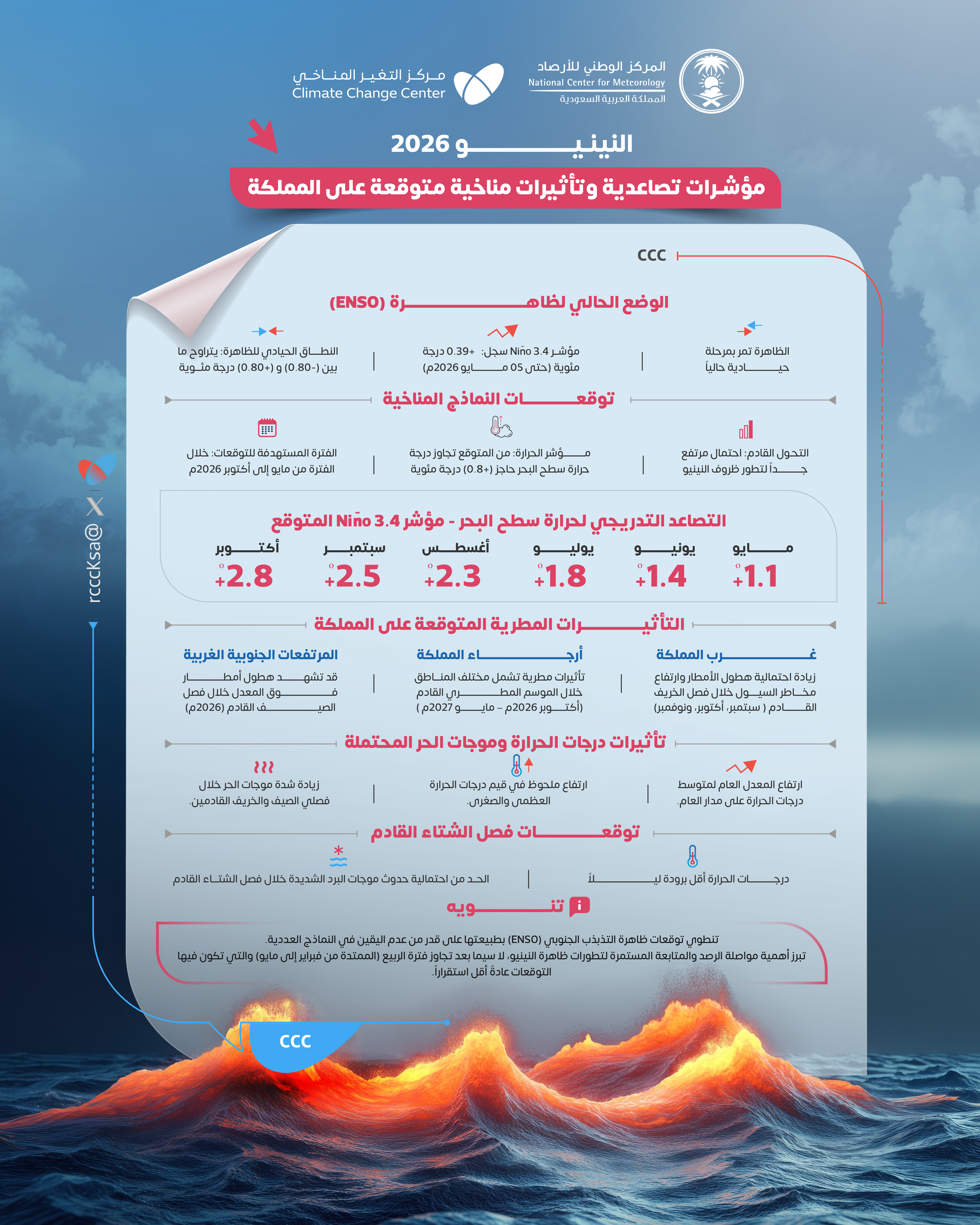
The Regional Center for Climate Change (RCCC) issued a report on the El Niño Southern Oscillation (ENSO) phenomenon, in which it explained that the phenomenon is currently going through a neutral phase, based on the latest climate observations until May 05, 2026, where the value of the Niño 3.4 index reached about (+0.39) degrees Celsius, which is within the neutral range of the phenomenon ranging between (-0.80) and (+0.80) degrees Celsius.
The report indicated that the monthly forecasts for the Niño 3.4 index during the period from May to October 2026 show a very high probability of the development of El Niño conditions, as a result of the sea surface temperature exceeding the barrier of (+0.8) degrees Celsius, with the expectation that the differences will continue to rise gradually from the normal rate in the coming months, as it is expected to reach (+1.1) degrees Celsius in May, (+1.4) degrees Celsius in June, (+1.8) degrees Celsius in July, and (+) 2.3 degrees Celsius in August, and +2.5 degrees Celsius in September, reaching +2.8 degrees Celsius in October 2026.
The report explained that the El Niño-Southern Oscillation (ENSO) phenomenon may lead to an increase in the likelihood of rainfall and a high risk of flooding in western Saudi Arabia during the upcoming autumn season, specifically during the months of September, October and November, in addition to the possible rainy effects on various parts of the Kingdom during the next rainy season from October 2026 to May 2027.
The report also pointed out that the southwestern highlands are likely to witness above-normal rainfall during the upcoming summer of 2026, in addition to the possibility of higher average temperatures throughout the year, and higher maximum and minimum temperatures, which may increase the intensity of heat waves during the coming summer and autumn, reduce the drop in temperatures at night, and reduce the possibility of severe cold waves during the coming winter.
The report indicated that the forecasts of the El Niño-Southern Oscillation (ENSO) phenomenon inherently involve a degree of uncertainty related to numerical models, which calls for continued monitoring and continuous follow-up of the phenomenon's developments, especially after surpassing the spring period from February to May, which is considered one of the less stable periods in the climate projection.

 العربية












.png)